PPF vs Mutual Fund SIP: Which is Better for Long-Term Wealth Creation?

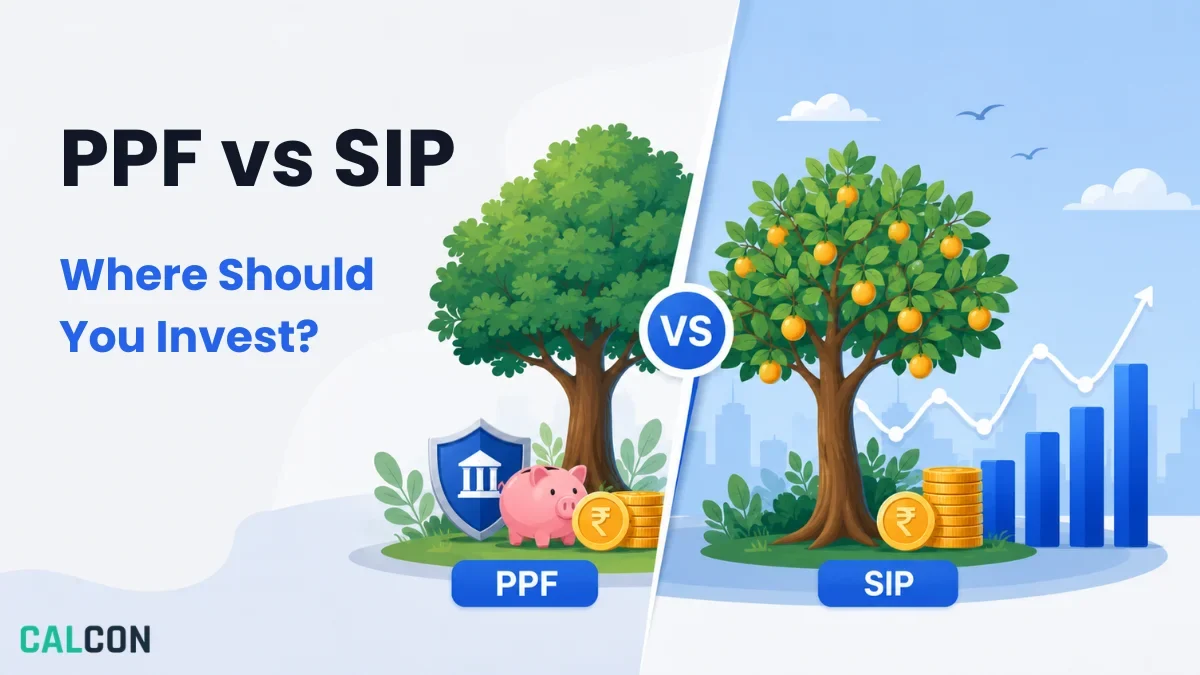
When it comes to building long-term wealth in India, two investment avenues dominate the conversation: the Public Provident Fund (PPF) and Mutual Fund Systematic Investment Plans (SIP). Both serve the purpose of disciplined saving, but they operate on completely opposite financial philosophies.
PPF is backed by the Government of India, offering guaranteed, tax-free returns with zero risk. On the other hand, an SIP is a gateway to equity markets, offering inflation-beating growth but with market-linked risks. If you are asking yourself, "Should I secure my future with PPF or maximize my wealth with an SIP?", this deep-dive guide will help you make an informed decision based on your financial goals.
What is Public Provident Fund (PPF)?
The Public Provident Fund is a government-backed, fixed-income savings scheme introduced to mobilize small savings for retirement. Since it is sovereign-backed, your principal amount and the interest earned are 100% safe. PPF comes with a mandatory lock-in period of 15 years, making it an excellent tool for ultra-long-term, risk-free goals like a child’s higher education or marriage.
What is a Mutual Fund SIP?
A Systematic Investment Plan (SIP) is not an investment scheme itself, but a method of investing regularly in mutual funds. Instead of timing the market or deploying a massive lump sum, an SIP lets you invest a fixed amount (monthly or weekly) into equity or debt funds. Over time, it leverages rupee cost averaging to smooth out market volatility and harness compounding growth.
PPF vs Mutual Fund SIP: Head-to-Head Comparison
To understand which tool fits your portfolio, let’s evaluate them across critical financial parameters:
Feature | Public Provident Fund (PPF) | Mutual Fund SIP (Equity) |
Returns | Fixed/Guaranteed (Reviewed quarterly by Government) | Market-linked (Variable but historically higher) |
Average Rate | Typically 7.1% - 7.5% | Typically 12% - 15% (Long-term equity) |
Risk Level | Zero Risk (Sovereign guarantee) | Moderate to High (Subject to market cycles) |
Lock-in Period | 15 Years (Partial withdrawals allowed after 7 years) | None (Except ELSS tax funds which have 3 years) |
Taxation | EEE Category (Exempt-Exempt-Exempt) | LTCG tax applicable on equity gains above ₹1.25 Lakh |
The Power of Compounding: A Real-World Example
Let's look at how the math plays out over a 15-year period. Suppose you decide to invest ₹10,000 every month for exactly 15 years.
Scenario A: Investing in PPF (Assumed 7.1% Constant Rate)
Total Amount Invested: ₹18,00,000
Estimated Interest Earned: ~₹14,54,500
Maturity Wealth: ~₹32,54,500 (Completely Tax-Free)
Scenario B: Investing via Mutual Fund SIP (Assumed 12% Conservative Equity Return)
Total Amount Invested: ₹18,00,000
Estimated Wealth Gain: ~₹32,45,700
Maturity Wealth: ~₹50,45,700 (Subject to Long-Term Capital Gains Tax)
Note: You can instantly cross-verify these calculations and try out different monthly investment amounts dynamically using the live SIP Return Calculation Engine or estimate your guaranteed corporate fund growth using our specialized PPF Calculator.
Which One Should You Choose?
The ideal strategy depends entirely on your risk tolerance and investment timeline:
Choose PPF if: You are a conservative investor, looking strictly to preserve capital, want a secure cushion for retirement corpus, or want absolute protection from market volatility.
Choose Mutual Fund SIP if: You have an investment horizon longer than 5-7 years, wish to beat long-term inflation, and possess the emotional stomach to stay invested through temporary market drawdowns.
The Pro-Tip: Don't treat them as rivals. A balanced asset allocation strategy involves allocating a percentage of your savings into PPF for capital safety, while fueling an equity SIP with the remaining portion to fast-track asset compounding.
Frequently Asked Questions (FAQs)
Q: Can I lose money in a Public Provident Fund (PPF)?
A: No, you cannot lose money in PPF. It is fully backed by the Government of India, meaning your investment capital and accumulated interest carry absolute safety from capital loss.
Q: Are Mutual Fund SIP returns guaranteed?
A: No. Mutual fund investments are linked to market performance, so returns are never fixed or guaranteed. However, historically, equity mutual funds have delivered anywhere between 12% to 15% annualized returns over an ultra-long horizon of 10+ years.
Q: Can I stop my SIP or close my PPF prematurely?
A: You can pause or stop your mutual fund SIP instantly at any point without penalties. However, PPF accounts cannot be fully closed before the 15-year maturity term, except under critical exceptions like severe medical emergencies or higher education expenses after 5 years.
Q: Which investment scheme offers better tax savings?
A: PPF offers superior tax structure under the EEE (Exempt-Exempt-Exempt) category, making investment, accumulation, and withdrawal completely tax-exempt. Mutual fund SIP returns attract Long-Term Capital Gains (LTCG) tax of 12.5% on profits that exceed ₹1.25 Lakh in a financial year.
Related Tools
Get new tools & guides
Occasional updates, no spam.