
PPF vs SIP: Where Should You Put Your Money?
Imagine you get some pocket money and you want it to grow. You could keep it somewhere very safe where it grows slowly but surely. Or you could put it somewhere that might grow faster, but some months it grows a lot and some months it shrinks a bit. That, in simple words, is the difference between PPF and SIP.
Lots of people in India ask which one is better. The honest answer is that neither one is the winner for everyone. They are good at different things. Once you understand what each one does, you'll know which fits you. Let's break it down in plain language.
What is PPF?
PPF stands for Public Provident Fund. Think of it as a special savings box that the government takes care of. You put money in, and the government adds interest to it every year. Right now that interest is about 7.1% a year, and it has stayed steady for a long time.
Here are the simple things to know about PPF:
It is very safe. Because the government backs it, you don't have to worry about losing your money.
The money grows at a fixed rate, so you always know roughly what you'll get.
You can put in as little as ₹500 and as much as ₹1.5 lakh in one year.
The money stays locked for 15 years. You can take a small part out after 7 years if you really need to.
You pay zero tax on the interest you earn. What grows is fully yours.
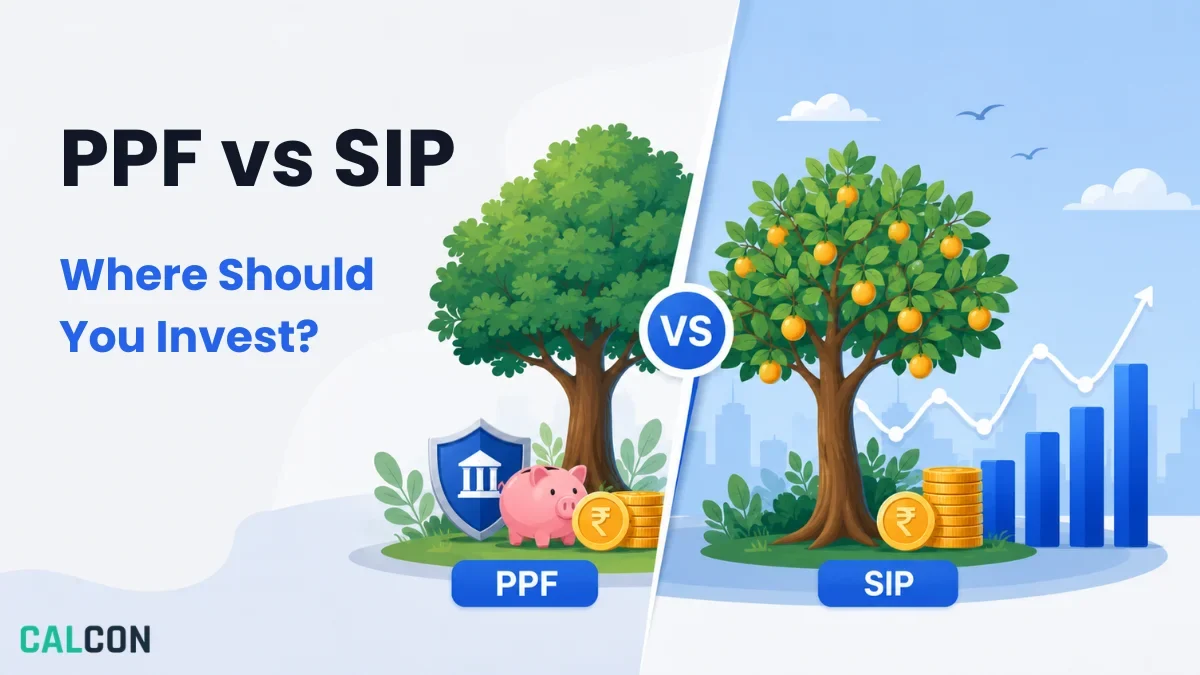
So PPF is like planting a strong, slow tree. It won't shoot up overnight, but year after year it quietly grows, and you know it will be there when you need it.
Calculate with our PPF Calculator
What is SIP?
Here is something many people get confused about, so let's clear it up first. SIP is not a thing you buy. SIP stands for Systematic Investment Plan, and it simply means putting a fixed amount of money every month into something called a mutual fund.
A mutual fund is a big basket. Many people put money into it, and experts use that money to buy small pieces of lots of companies. When those companies do well, your money grows. When they don't, your money can dip. A SIP is just the habit of adding a little to that basket every month, like ₹500 or ₹1,000, instead of a big amount all at once.
Here are the simple things to know about a SIP:
The money is not fixed or promised. It grows with the market, which moves up and down.
Over many years it has often grown faster than safe options, but there is no guarantee.
It is flexible. You can usually pause it or take your money out when you want. Some special funds do lock money for about 3 years.
You may need to pay a little tax on the profit you make.
So a SIP is like planting a fruit tree in a garden with changing weather. In good years it gives lots of fruit. In tough years, less. But given enough time and patience, it often grows into something big.
Calculate with our SIP Calculator
PPF vs SIP: a quick side by side
Here is the easiest way to see the difference at a glance:
Let's compare | PPF | SIP (into mutual funds) |
|---|---|---|
How safe is it? | Very safe. The government looks after it. | ess safe. It goes up and down with the market. |
What do you earn? | A fixed rate, about 7.1% right now, and it's tax free. | Not fixed. Could be more, could be less. Nobody can promise. |
How risky is it? | Almost no risk. | Some risk, especially if you take the money out early. |
How long is it stuck? | Locked for 15 years. You can take a little out after year 7. | Flexible. You can usually stop or withdraw anytime. Some funds lock money for 3 years |
What about tax? | You pay no tax on what you earn. | You may have to pay some tax on your profit. |
Best for | Money you want kept safe and won't touch for years. | Growing money over many years if you're okay with ups and downs. |
A small story to make it clear
Let's say two friends, Aarav and Meera, each decide to save ₹1,000 every month for 15 years. That is ₹1.8 lakh each over the whole time.
Aarav chooses PPF. Because the rate is steady and safe, his money grows to roughly ₹3.25 lakh by the end, and he pays no tax on it. He always knew about how much he would get, and he never lost a night's sleep over it.
Meera chooses a SIP into a mutual fund. Her money bounced up and down over the years. Some years were scary, some were happy. If her fund grew at a good average pace, she might end up with around ₹4.5 lakh, which is more than Aarav. But here is the catch: nobody could promise her that number in advance. She could have ended with more, or with less. She took a chance, and she needed patience to ride out the bad years.
These numbers are just examples to show the idea. Real results depend on the actual rate and how the market behaves. The point is simple: PPF gives you a calmer, surer, smaller result, while a SIP offers the chance of more, with some bumps along the way.
So which one should you choose?
Here is the friendly truth: you don't always have to pick just one. Many smart savers use both, and that is often the wisest move.
You might lean towards PPF if you want your money kept very safe, you're saving for something far in the future, and you don't like the idea of your money going down even for a little while.
You might lean towards a SIP if you have many years to invest, you're okay seeing your money wobble in the short term, and you want a shot at growing it faster over the long run.
A common approach is to keep some money in PPF as your safe base, and put some into a SIP for growth. That way you get a bit of both: safety and the chance of more. How much goes where depends on your goal, how many years you have, and how comfortable you feel with risk.
Try it with your own numbers
The best way to decide is to play with real figures. Use our PPF calculator to see how a safe, fixed amount would grow, and our SIP calculator to see how a monthly investment might grow at different rates. Change the amount and the number of years, and watch how the results shift. Seeing your own numbers makes the choice much easier.
Frequently asked questions
Is PPF better than SIP?
Neither is better for everyone. PPF is safer and gives a fixed, tax free return, while a SIP can grow more over the long term but moves up and down. The right choice depends on your goal and how comfortable you are with risk.
Can I invest in both PPF and SIP?
Yes, and many people do. Keeping some money in PPF for safety and some in a SIP for growth is a popular and balanced way to save.
Is SIP safe like PPF?
Not in the same way. PPF is backed by the government and your money does not fall. A SIP invests in the market, so it can go up and down, though over many years it has often grown well.
How much money do I need to start?
You can start a PPF with as little as ₹500 in a year, and many SIPs let you begin with around ₹500 a month. You do not need a big amount to start either one.
Do I pay tax on PPF or SIP?
PPF interest is completely tax free. With a SIP, you may have to pay some tax on the profit you earn, depending on the type of fund and how long you stay invested.
A friendly note: This guide is here to help you understand your options in simple words. It is not financial advice, and the example numbers are only for learning. Market returns are never guaranteed, so if you plan to invest a large amount, it's a good idea to talk to a trusted adult or a qualified financial advisor first.
Related Tools
Get new tools & guides
Occasional updates, no spam.
Latest Posts
SCSS vs CSS: What's the Difference & How to Compile SCSS to CSS
PPF vs Mutual Fund SIP: Which is Better for Long-Term Wealth Creation?

How to Resize Photo & Signature for Online Exam Forms (Size + KB Guide)
How to Resize Image Dimensions Online (Width, Height & Aspect Ratio)
How to Remove a Password from a PDF (Unlock PDF Free)